
Ganesh Ramachandra Behere:
A Voice Echoing Through Time
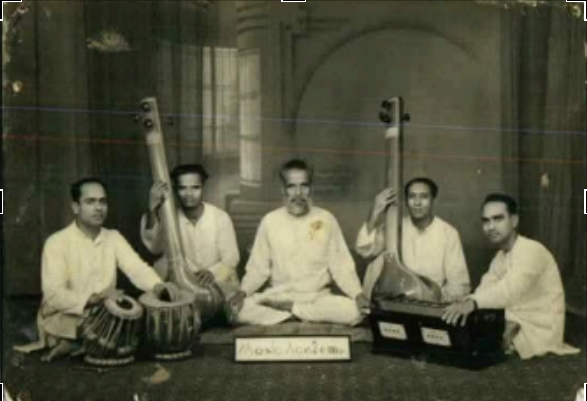

Early Life and Musical Inclination
Ganesh Ramchandra Beherebua was born in 1890 in the village of Kurdhen, located in the Ratnagiri district of Maharashtra. From an early age, he exhibited exceptional musical talent. A natural prodigy, he was adept at playing various musical instruments available during his time and had a remarkable ear for melody.
Initial Training and Musical Exposure
Recognizing his potential, a contemporary associate introduced young Beherebua to the Kirloskar Natak Mandali, a prominent theatre company. There, he began formal training under the renowned maestro Pandit Bhaskarbuwa Bakhale. He later received further guidance from Ramakrishnabuwa Vaze during his time with Lalitkaladarsh Sangeet Natak Mandali, further shaping his musical foundations.

Discipleship under Ustad Abdul Karim Khan
A turning point in Beherebua's musical journey came in the early 1900s when Ustad Abdul Karim Khan, founder of the Kirana Gharana, settled in Mumbai. Upon meeting the Ustad, Beherebua found his true musical calling. He underwent the traditional Ganda Bandhan ceremony, formally becoming a disciple of Abdul Karim Khan. Under his tutelage, Beherebua rigorously practised and mastered the Kirana style of Hindustani classical vocal music. He often accompanied his guru on the tanpura, contributing to many of his live performances across the country.
Teaching and Contribution to Musical Education
Beherebua extended his passion for music through teaching. He started a modest music school in Mumbai and also served as a music teacher in municipal schools under the Bombay Municipal Corporation. Through these efforts, he nurtured a new generation of classical musicians and contributed meaningfully to the propagation of Hindustani classical music in urban settings.
Performances and Musical Legacy
Over the years, Beherebua performed extensively across India. He was frequently accompanied by his son, Ramakrishnabua Behere, and Mr Madhukar Pednekar on harmonium. His recitals featured in various music conferences and All India Radio programs, gaining him recognition as a refined and soulful performer of the Kirana tradition.

Recognition and Later Life
In recognition of his outstanding service to Hindustani classical music, Ganesh Ramchandra Beherebua was honoured with the prestigious Sangeet Natak Akademi Award in 1958. A deeply spiritual man, he was also a devoted follower of Lord Dattatreya. After retirement, he returned to his native village of Kurdhen, where he built a small Dattatreya temple and spent the remainder of his life in devotion and peace.

Legacy
Ganesh Ramchandra Beherebua passed away in 1965, leaving behind a rich musical legacy that bridged rigorous classical tradition and heartfelt devotion. His life continues to inspire students, performers, and connoisseurs of Indian classical music.
Here are three full-length recordings of Beherebuwa, featuring Raag Lalit Jogiya and Bihag
The above recording presents Raag Lalit. Beherebuwa performs two traditional bandishes: “Rain Ka Sapna” in Vilambit Ektal and “Bhavanda Yaar Da Joban” in Drut Teentaal. The Vilambit Khayal, though not as slow-paced as typically heard today, still reflects the aesthetic sensibilities passed down from Ustad Abdul Karim Khan to Beherebuwa. In the faster section, Beherebuwa introduces traditional layakari, likely influenced by his training under Ustad Rajab Ali Khan. The recording showcases Beherebuwa’s stylistic blend—Abdul Karim Khan’s subtlety in Vilambit and Rajab Ali Khan’s rhythmic brilliance in Drut layakari.
The above recording features Raag Jogiya. Compared to the earlier one, it is somewhat shorter in duration. He performs a composition in Jhaptal set to Madhyalay. Although the lyrics are not entirely clear, the badhat or improvisation is very much similar to the one by Ustad Abdul Karim Khan's 78RPM recording of raag jogiya. Unlike the previous piece, Beherebuwa avoids complex layakari, opting instead for a melodic and playful rendition—an essential characteristic of Madhyalay performance.
The recording presented above is of Raag Bihag. This particular rendition differs noticeably from the two earlier recordings in several aspects. It features extended alapis that incorporate Dhrupad-like elements, especially the use of nom–tom syllables and the characteristic patterns associated with this style. These elaborate alapis set a contemplative and deeply expressive tone at the beginning of the performance. After the prolonged and intricate alap section, Beherebuwa shifts his focus towards the bandish, offering a unique and innovative interpretation of the mukhda of the well-known khayal, "Kaise Sukh Sovay." The recording is believed to date back to around the year 1962 and has been made available to the public through a YouTube upload by the channel named ‘Pokri Poki’.

Note: In all three recordings above, the tanpuras—tuned with great care by Beherebuwa—are clearly audible and play a vital role in shaping the mood of each performance. The first string is tuned to Nishad (Ni) with a slightly open jawari, creating a warm, resonant drone reminiscent of his guru, Ustad Abdul Karim Khan’s style.
This thoughtful tuning reflects Beherebuwa’s meticulous attention to tonal detail and his deep respect for tradition. For him, the tanpura was not just an accompanying instrument but a foundational element of the raga’s emotional and spiritual expression.
References
Internet Archive https://drive.google.com/file/d/1cI7h38prT3ft96ox1gFGExKx9UFeKGsL/view?usp=drivesd
YouTube
Picture 1 - Kirana Gharana FB page
Picture 2 - G Katyan Mishra Twitter handle
Picture 6 - Scroll.in
Picture 7 - Sangeet Natak Academy website https://sangeetnatak.gov.in/public/uploads/awardees/docs/Ganesh%20Ramchandra.pdf
Picture 12 - Vintage Raga Sangeet FB page https://www.facebook.com/share/19DbniKk9c/

Comments