
Pandit Anant Manohar Joshi; Antubuwa
Guardian of Gwalior Gayaki
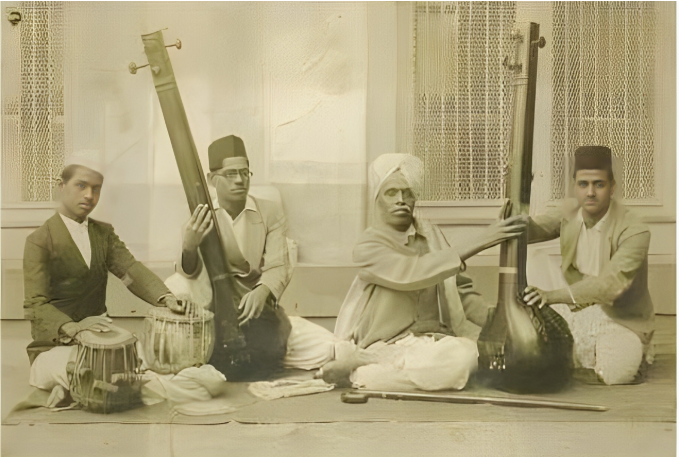
Early Life: A Musical Legacy Begins
In the year 1881, the village of Kinhai, nestled near Aundh in Maharashtra, bore witness to the birth of a child destined to shape the course of Hindustani classical music—Anant Manohar Joshi, later affectionately known as Antubuwa.
Born into a musically gifted family, Antubuwa inherited the rich musical legacy of his father, Pandit Manoharbuwa, a singer known for his honeyed voice and captivating presence on stage. In those days, it was a rare honour to be the final performer in a lineup of musicians—a distinction regularly granted to Manoharbuwa.
But fate dealt a hard blow early in life. When Antubuwa was just seven, he lost his father. Yet, the young boy's journey did not waver. His mother, resolute in her son’s future, ensured he continued learning. After some initial training under a musician named Mr Ayachit, she took him to none other than Pandit Balkrishnabuwa Ichalkaranjikar, a towering figure of the Gwalior Gharana.

Shaped by the Gwalior Tradition
Under Balkrishnabuwa’s guidance, Antubuwa trained for nearly a decade, absorbing the essence of the Gwalior Gayaki with intensity and reverence. It was here that the roots of his musical character were firmly planted—roots that would eventually nourish an entire generation of musicians.
At the age of seventeen, a fortuitous opportunity arrived. Antubuwa was invited to accompany Ustad Rehamat Khan Saheb—the son of the legendary Ustad Haddu Khan, one of the originators of the Gwalior Gharana. Travelling and performing alongside the Ustad, young Antubuwa’s musical soul was enriched beyond measure.

Mumbai and the Scholar’s Voice
The journey with Rehamat Khan eventually led him to Mumbai, where Antubuwa began carving a life not only as a performer but also as a teacher and scholar. His school of music, open for nearly eight hours daily, became a vibrant space of learning. He also wrote and published books, simplifying music education for eager beginners.

In this intense atmosphere of daily practice and teaching, his young son Gajananbuwa—himself a future titan—absorbed music like a sponge. As Antubuwa once said, “Gajanan picked up Gayaki like blotting paper!” The Gwalior tradition was not only being preserved—it was evolving through the bloodline.
Return to Aundh: The Court Musician
Life’s tides shifted again, and Antubuwa returned to Aundh, where he was welcomed with warmth by Prince Balasaheb Pantapradhinidhi, a connoisseur and generous patron of the arts. Once again, Antubuwa became a court musician, a role both prestigious and creatively fulfilling.
Even as age caught up and his vocal tone lost some of its youthful sweetness, his presence remained magnetic. He continued performing, though for shorter durations, always reminding audiences of the depth and dignity of the Gwalior style.


Bhawanrao aka Balasaheb pantapratinidhi, a patron to arts and artists, himself being an accomplished painter, and an erudite musical kirtankar. In addition to publishing Chitra Ramayana, he also illustrated the pictures in the book. This image is of the Coronation of Sri Ramachandra on the Throne of Raghuvamsha.
Musical Lineage and Legacy
Though Antubuwa was rooted in the Gwalior Gayaki, he was no stranger to the nuances of the Jaipur and Agra gharanas. His wide musical exposure made him a true confluence of classical traditions.
His disciples included some of the finest musical minds of their time, Pandit Gokhlebuwa, Pandit Godbolebuwa, Professor Chaugule, Pandit D.R. Nimbargi, and Pandit S.N. Ratanjankar, each of whom made significant contributions to Indian classical music. Among them, his son, the legendary Pandit Gajananbuwa Joshi, stood out as a true torchbearer of his father’s legacy.
In a memorable incident, Ustad Faiyaz Khan of the Agra Gharana, after listening to Gajananbuwa’s singing for three days, asked him if he had ever met Rehamat Khan Saheb. Astonished to learn he hadn’t, Ustad marvelled at how clearly his Gayaki was reflected in Gajananbuwa’s voice, a testimony to the power of Antubuwa’s musical transmission.

Final Years and Passing
Antubuwa spent his final years surrounded by music and family. He passed away on 12th September 1967, at the home of his son Gajanan in Dombivli, Mumbai. Though the voice fell silent, its echoes can still be heard through recordings, disciples, and the enduring legacy of his son. Listening to Antubuwa is not just hearing music; it is touching the very roots of Gwalior Gayaki.
Below are two recordings of Antubuwa featuring Raag Ramkali and
Raag Samant Sarang
The recording above features Raag Ramkali, a serene and introspective morning raga known for its meditative and devotional character. In this rendition, Antubuwa presents the traditional composition “Tu Hi Kartar, Jagat Aakar,” set to Madhya Drut Teentaal. The composition is delivered with a sense of quiet dignity, allowing the raga's inherent depth and gravitas to surface gradually.
What stands out in this recording is the organic manner in which the bandish is allowed to breathe and develop. Rather than rushing through its sections, Antubuwa nurtures each phrase, allowing space for melodic exploration and subtle rhythmic variations. This approach not only showcases the internal strength of the bandish but also creates an intricate rhythmic interplay—a distinctive trait of the traditional Gwalior gayaki.
The rendition is further enriched by a sense of spiritual detachment and inward reflection, suggesting the influence of Antubuwa’s guru, Ustad Rehmat Khan. The ascetic idealism often associated with Khan’s music is subtly woven into the fabric of this performance, lending it a quiet intensity and emotional restraint that is both profound and deeply moving.
The recording above features Raag Samant Sarang, presented by Antubuwa through two compositions: the bada khayal “Aye Mayi Ri” in Vilambit Tilwada, and the chota khayal “Madhur Madhur” in Drut Ektal. The initial alapi preceding the bandish spans the full range of the raga—from the mandra saptak to the taar saptak—and is further expanded within the vilambit khayal.
Antubuwa, a seasoned vocalist of the Gwalior Gharana, skillfully constructs his raag development through aavartans (rhythmic cycles), using bol-alap as a foundation and gradually progressing into intricate laykari. His delicate use of shuddha dhaivata adds a refined beauty to the raga's character. The repeated cycles of the sthayi and antara sections reveal the complete structural essence of the composition.
The bol-baant in this rendition explores the rhythmic nuances and playfulness embedded within the bandish. The chota khayal serves as a fitting conclusion, gracefully gathering the expansive melodic development back into a compact and vibrant rhythmic cycle.
References
Wikipedia page on Antubuwa
Gayanacharya Manohar Pandit Anant Joshi; a book by G.H.Ranade
Gajananbuwa Joshi website
Image 1 — Gajananbuwa Joshi website
Image 2 — HCMAE FB page
Image 5 — Bajakhana
Image 7 — Pallavi Manohar Joshi FB page https://www.facebook.com/share/p/19VfdVtpL3/
Image 8 — Bhawanrao Pantapratinidhi Wikipedia page https://en.m.wikipedia.org/wiki/File:Bhawanrao_Shriniwasrao_Pant_Pratinidhi.jpg
Image 9 — Bhawanrao Pantapratinidhi Wikipedia page https://en.m.wikipedia.org/wiki/File:Rama_was_become_King_of_Kosala.jpg
Image 11 — Ulhas Kashalkar website

Comments